
How to Choose the Right Sunscreen for Desert Climates
Arid environments place a distinct set of demands on the skin barrier. This guide sets out what to look for on a sunscreen label, and how to wear it consistently in Gulf and wider Middle Eastern conditions.
Protection level
SPF 50+ / PA++++
Water resistance
40–80 minutes
Reapplication
Every 2 hours outdoors
Daily amount
2 mg per cm² of skin
Sun protection advice is often written for temperate climates: a summer holiday, a few intense weeks, then a long low-UV winter. Desert regions do not follow that pattern. Ultraviolet exposure is high for most of the calendar year, ambient temperatures accelerate perspiration, and the movement between fierce outdoor light and heavily air-conditioned interiors places the skin barrier under repeated stress. Choosing a sunscreen for these conditions is therefore less about seasonal habit and more about selecting a product robust enough to be worn every single day.
Why desert climates require a different standard of sun protection
Three environmental factors matter most. The first is UV intensity. Clear skies, low humidity and a high solar angle mean the UV index across the Arabian Peninsula and North Africa regularly reaches very high or extreme levels between spring and autumn — often index 9 to 11 or above around the middle of the day. At those levels, unprotected fair to medium skin can register visible erythema, or sunburn, within roughly fifteen minutes.
The second is reflection. Pale sand, concrete, glass façades and open water all bounce ultraviolet radiation back upward. Shade reduces exposure but does not eliminate it: a parasol or a covered walkway can still transmit a meaningful proportion of scattered and reflected UV to the face, neck and forearms.
The third is heat and dryness. Sustained high temperatures increase sweating, which physically displaces sunscreen from the skin surface, while low ambient humidity and prolonged air conditioning increase transepidermal water loss. A film that has partly washed away, or a product too drying to be worn daily, protects nobody. Any sunscreen intended for desert use has to survive perspiration and support hydration at the same time.
UVA and UVB: understanding what you are protecting against
Sunlight reaching the skin includes two dermatologically significant ultraviolet wavelength bands. They behave differently, and a well-chosen sunscreen addresses both.
UVB — the shorter, burning wavelengths
UVB radiation (approximately 280–315 nm) is absorbed mainly in the epidermis. It is the principal cause of sunburn and direct DNA damage in keratinocytes, and it drives the cumulative risk of keratinocyte carcinoma. UVB intensity varies sharply with time of day, season and altitude, peaking in the hours either side of solar noon. The SPF number on a label is measured primarily against UVB.
UVA — the longer, ageing wavelengths
UVA radiation (approximately 315–400 nm) penetrates more deeply, into the dermis, where it generates reactive oxygen species that degrade collagen and elastin. It contributes to photoageing, loss of firmness and pigmentary disorders including melasma and post-inflammatory hyperpigmentation — a common concern in the region. Crucially, UVA levels are far more constant than UVB: they remain substantial in early morning and late afternoon, during overcast weather, and they pass readily through window glass in a car or an office.
This is why the phrase to look for is broad spectrum. On European-style labelling it is often expressed as a UVA circle logo or a UVA protection factor of at least one third of the stated SPF; Asian labelling commonly uses the PA system, where PA++++ indicates the highest tested UVA protection grade. A high SPF with weak UVA coverage will stop you burning while leaving the ageing and pigmentation pathway largely open.
Why SPF 50+ is the sensible baseline in the region
Sun protection factor describes how much longer skin protected by a correctly applied film takes to redden compared with unprotected skin, under laboratory conditions. In absolute filtration terms, SPF 30 blocks roughly 97 per cent of incident UVB and SPF 50 approximately 98 per cent. The difference sounds trivially small, but it is more usefully read the other way around: the transmitted dose falls by about a third, from around 3.3 per cent to 2 per cent.
That margin matters in a desert climate for two reasons. Total daily UV dose is high, so a proportional reduction translates into a meaningful absolute reduction. And real-world application is almost always thinner than the 2 mg/cm² used in testing — studies repeatedly find people apply between a quarter and a half of that. Because protection does not scale linearly with film thickness, a product labelled SPF 50+ applied imperfectly may behave closer to an SPF in the twenties. Starting from a higher tested figure builds in tolerance for ordinary human error.
SPF 50+ is particularly worth prioritising if you:
- spend more than a few minutes outdoors in the middle of the day, including commuting on foot
- are treating pigmentation, melasma or post-acne marks, where UV exposure undermines results
- use retinoids, exfoliating acids or have recently had a professional resurfacing treatment
- take photosensitising medication, or have a personal or family history of skin cancer
- work near reflective surfaces such as sand, water, glass or pale stone
Water resistance, sweat and the realities of heat
Water resistance is a tested claim, not a marketing adjective. A product labelled water resistant has maintained its stated SPF after 40 minutes of water immersion; very water resistant indicates 80 minutes. No sunscreen is waterproof, and no regulator permits that word.
In practice, the same property governs sweat resistance, which is the more relevant concern for daily wear at 40 °C. A film that resists perspiration stays where it was placed instead of migrating into the eyes or slipping off the nose and forehead by mid-morning. Look for a water-resistant claim if you commute outdoors, exercise, or spend time at the beach or pool, and reapply after towel drying — mechanical friction removes more product than water alone.
Daily application: how much, how often, and where people go wrong
The most common failure in sun protection is not product choice but quantity and frequency. Two practical measures make this easy to get right.
Quantity
For the face and neck, a useful guide is the two-finger rule: a line of product along the length of the index and middle fingers, applied in two passes so the film is even. For the whole body, roughly 30 ml — about a shot glass — is needed to reach the tested dose. Do not forget the ears, the hairline and parting, the sides and back of the neck, the backs of the hands and the tops of the feet.
Frequency
Apply as the final step of your morning skincare routine, before makeup, and allow a couple of minutes for the film to set. Reapply every two hours of continuous outdoor exposure, and after swimming, heavy sweating or towel drying. For a day spent entirely indoors away from windows, a single morning application is usually adequate — but if you sit beside glass, UVA continues to reach you, so a midday top-up is worthwhile.
Consistency outperforms intensity. A moderate product worn every day protects more effectively than an excellent one used occasionally, which is why texture, finish and comfort are legitimate clinical considerations rather than vanity ones.
Wearing sunscreen under makeup
Sunscreen and makeup coexist comfortably when the order and the timing are respected. Apply sunscreen as the final step of your skincare routine on clean, dry skin, then wait one to two minutes. Only then apply primer, foundation or powder. Layering too quickly, or rubbing rather than pressing, is what causes pilling — those small rolls of product that appear when films are disturbed before they have set.
- Choose a lightweight, non-greasy, invisible-finish sunscreen if you wear base makeup daily; heavy occlusive textures are more likely to pill or slide in heat.
- Press foundation on with a damp sponge or fingertips instead of dragging a brush across the sunscreen film.
- For reapplication over makeup, press a fresh layer on with clean fingers or a sponge, or use a mineral powder or cushion with SPF for a partial top-up — treat these as supplements, not replacements.
- Colour cosmetics with an SPF claim rarely deliver their tested protection, because nobody applies foundation at 2 mg/cm². Keep a dedicated sunscreen underneath.
Practical guidance for UAE and Middle East weather
Regional conditions justify a few specific habits beyond the general rules.
- Treat sun protection as a year-round routine. UV index values in the Gulf remain moderate to high even in the cooler months of December and January.
- Plan around the peak window. Between roughly 10:00 and 16:00 from April to September, seek shade and add physical barriers — a wide-brimmed hat, UV-filtering sunglasses and long, loosely woven sleeves.
- Account for indoor UVA. Long drives and desk positions beside glass deliver a real UVA dose; car side windows in particular filter far less than windscreens.
- Prioritise hydration in the formula itself. Air conditioning and dry desert air increase water loss, so a high-water, hydrating sunscreen supports barrier comfort without an extra layer.
- Choose sand- and sweat-friendly textures. Dust and fine sand cling to tacky films; a dry, invisible finish stays cleaner and more comfortable outdoors.
- Mind humid coastal cities. In Dubai, Abu Dhabi, Jeddah and Alexandria, high humidity slows evaporation and makes lightweight, water-resistant formulas markedly more wearable.
- Protect children and outdoor workers deliberately. Both groups accumulate substantial exposure; shade, clothing and scheduled reapplication matter as much as the product itself.
A checklist for reading the label
- SPF 50+ for daily use in high-UV environments
- Broad-spectrum protection, ideally with a UVA logo or PA++++ grading
- A tested water-resistance claim of 40 or 80 minutes
- A lightweight, invisible finish with no white cast on your skin tone
- Suitability for your skin type — non-comedogenic and fragrance-free if you are acne-prone or sensitive
- A texture you genuinely enjoy wearing, because daily use is what determines the outcome
Sand Touch SPF 50+ as a daily example
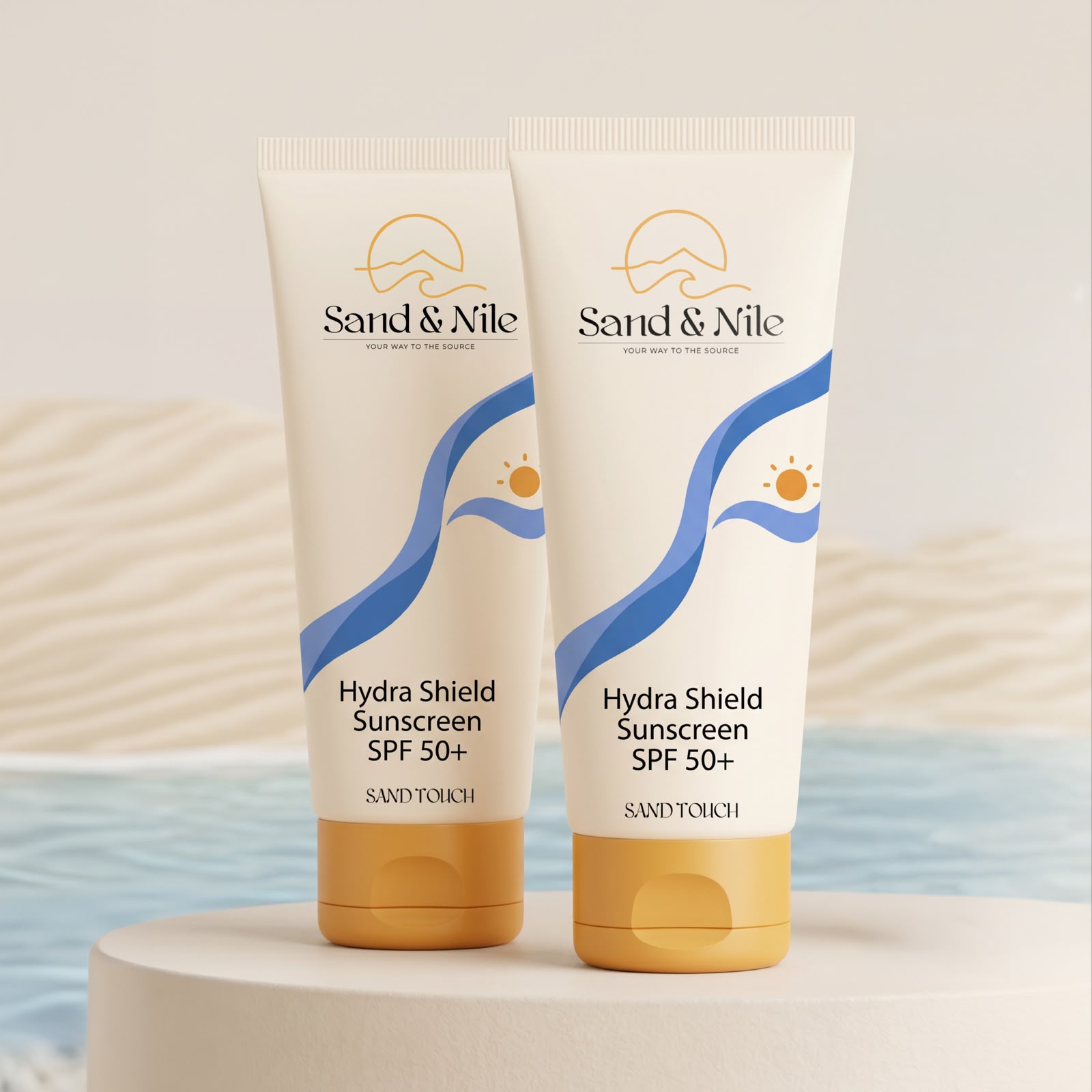
Formulated with these conditions in mind, Sand Touch SPF 50+ was developed as an advanced daily skincare step rather than a holiday product. It offers broad-spectrum UVA and UVB protection at SPF 50+, a water-resistant film suited to heat and perspiration, and a lightweight, invisible finish that sits comfortably under makeup on a range of skin tones — alongside hydrating ingredients that help the barrier cope with dry air and air conditioning.
It is one example of what a well-considered daily sunscreen for desert climates can look like. Sun protection remains a routine, not a single purchase: pair a suitable product, applied generously and consistently, with shade, clothing and sensible timing. For individual skin concerns, medication interactions or lesions that change in size, colour or shape, a dermatologist should always be consulted.
Sand and Nile
Questions about the formula, or interested in stocking it?
Our team is happy to talk through the formulation, or to discuss wholesale partnerships across the UAE, Egypt and the wider region.