How UV Rays Affect Your Skin Every Day
The exposure that shapes how skin ages is not the beach day. It is the accumulated quarter-hours of an ordinary week.
Ask someone when they were last exposed to the sun and they will name a holiday. Ask a dermatologist and the answer is: this morning, on the way to work, for eleven minutes. Chronic low-grade exposure — not the occasional burn — accounts for the majority of visible photoageing in most adults.
A day of ultraviolet, hour by hour
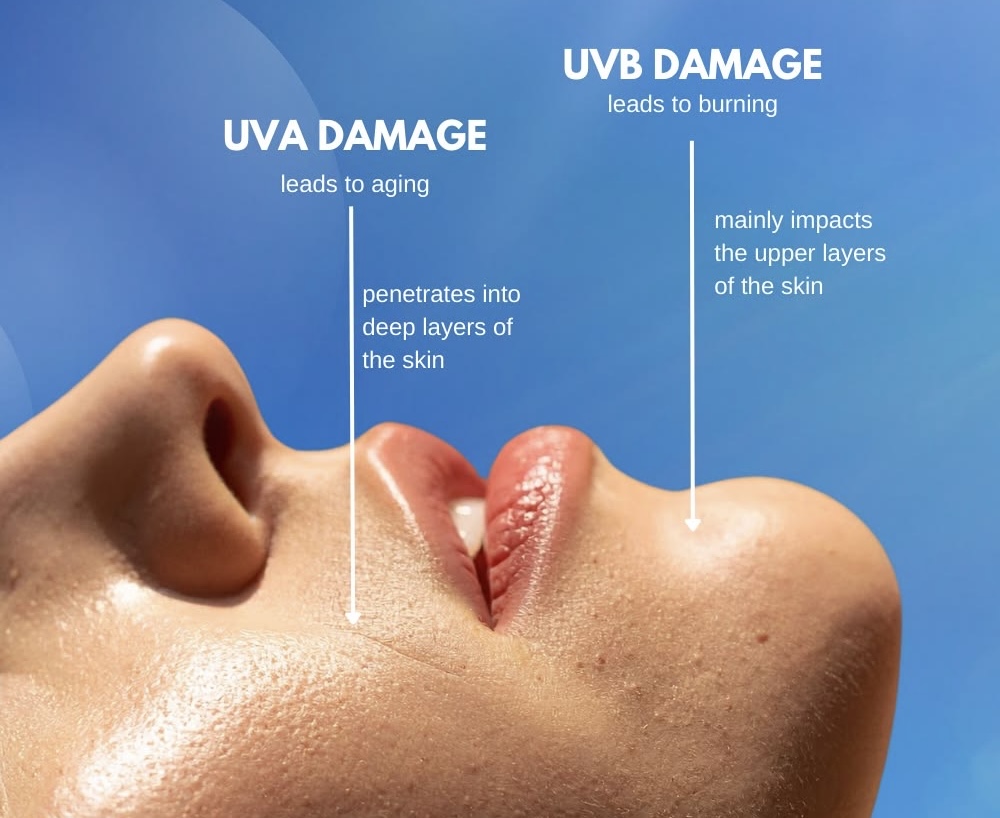
Ultraviolet radiation begins reaching the ground shortly after sunrise, rises to a peak between roughly 10am and 4pm, and falls away towards dusk. UVB is highly dependent on sun angle, which is why it dominates midday and summer. UVA is far more constant: it is present from early morning until late afternoon, in every season, and it passes through cloud and glass.
- The morning commute: direct exposure through a windscreen and side glass, predominantly UVA.
- A desk beside a window: continuous low-dose UVA for hours at a time.
- The walk to lunch: fifteen minutes near peak UVB intensity.
- The evening balcony or terrace: lower intensity, but a real dose nonetheless.
What happens in the epidermis
UVB is absorbed by DNA in keratinocytes, forming cyclobutane pyrimidine dimers — structural faults that the cell must repair before division. Repair systems are efficient but not perfect, and unrepaired faults accumulate as mutations. The visible short-term response is sunburn: an inflammatory reaction accompanied by programmed cell death in the most damaged cells.
Simultaneously, melanocytes increase melanin production and transfer pigment upward to shield the nuclei of surrounding cells. Tanning is not a sign of health; it is a documented injury response. In skin of colour, that same mechanism, once dysregulated, produces the stubborn hyperpigmentation that dominates dermatology consultations across the Middle East and North Africa.
What happens in the dermis
UVA penetrates deeper and works indirectly. It excites chromophores in the skin, which generate reactive oxygen species. Those species oxidise lipids and proteins and upregulate matrix metalloproteinases — enzymes that degrade collagen and elastin. Repeated activation over years produces solar elastosis: the thickened, yellowed, laxity-prone skin characteristic of long-term outdoor exposure.
The dermis also loses its ability to rebuild. UVA suppresses new collagen synthesis at the same time as it accelerates breakdown, which is why photoaged skin thins and slackens rather than simply wrinkling.
Beyond ultraviolet: visible light and infrared
Recent research has widened the frame. High-energy visible light — the blue-violet end of the spectrum, from sunlight far more than from screens — induces pigmentation in darker phototypes that is more persistent than UVB-induced pigment. Infrared-A contributes heat-driven matrix degradation. This is why pigmentation-prone patients often see incomplete results from a UV-only filter and benefit from formulas with antioxidant support.
Why the region matters
Across the Gulf and North Africa the UV index routinely reaches 10 to 12 for extended periods, and reflected light adds to the direct dose: dry sand returns roughly 15 to 20 per cent of incident UV, water up to 25 per cent at certain angles, pale stone and concrete a meaningful fraction more. Shade under an umbrella reduces exposure but does not eliminate it, because reflected and scattered radiation arrives from every direction.
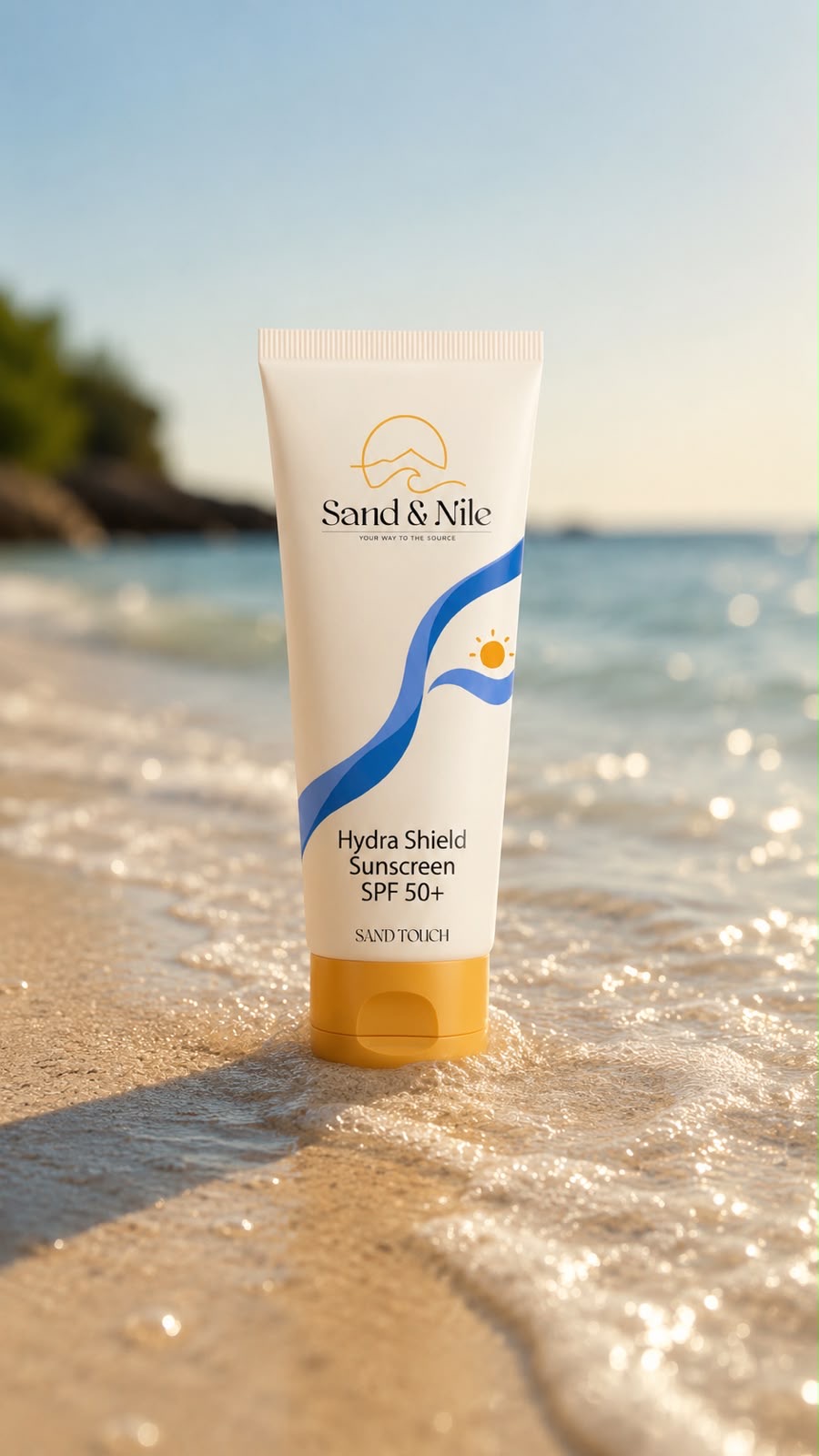
Sand Touch SPF 50+ was formulated against that ambient reality — broad-spectrum coverage in a hydrating base, designed to be worn daily in high-heat, high-humidity conditions rather than reserved for the beach.
The good news about accumulation
Because damage is cumulative, prevention is cumulative too. Reduce the daily dose and the yearly total falls immediately. Studies of consistent daily sunscreen use show not only slowed photoageing but measurable improvement in existing damage, as repair processes are finally allowed to outpace injury.
Ultraviolet exposure is not an event to be managed a few times a year. It is a daily variable, and the most effective response is equally ordinary: sunscreen every morning, sensible shade at midday, and a formula pleasant enough that the habit survives past week two.
The Journal
Sand Touch SPF 50+
Broad-spectrum protection in a hydrating base, designed for daily wear in regional light.