The Essential Role of SPF in a Healthy Skincare Routine
Actives correct. Sunscreen protects the correction. Without the second step, the first is a subscription rather than a result.

Skincare routines have grown more sophisticated and more expensive. Vitamin C in the morning, retinoid at night, exfoliating acids twice weekly, peptides, niacinamide, in-clinic treatments on a schedule. Yet the step that determines whether any of it holds is the least glamorous one, and it costs the least.
Protection precedes correction
Every corrective active in a routine works against a background rate of damage. Retinoids stimulate collagen synthesis; ultraviolet exposure accelerates collagen degradation. Brightening agents suppress excess melanin production; ultraviolet and visible light stimulate it. Without daily photoprotection, the routine runs a treadmill — real biological work, cancelled out before it accumulates into visible change.
This is also why so many pigmentation treatments appear to plateau. The active is doing its job; the daily dose of light is doing the opposite job at a similar rate.
Where sunscreen sits in the sequence
- Cleanse, then apply water-based treatments to dry skin.
- Allow each layer to settle before the next.
- Finish morning care with sunscreen — always the final skincare step.
- Allow a short absorption pause before makeup so the film sets evenly.
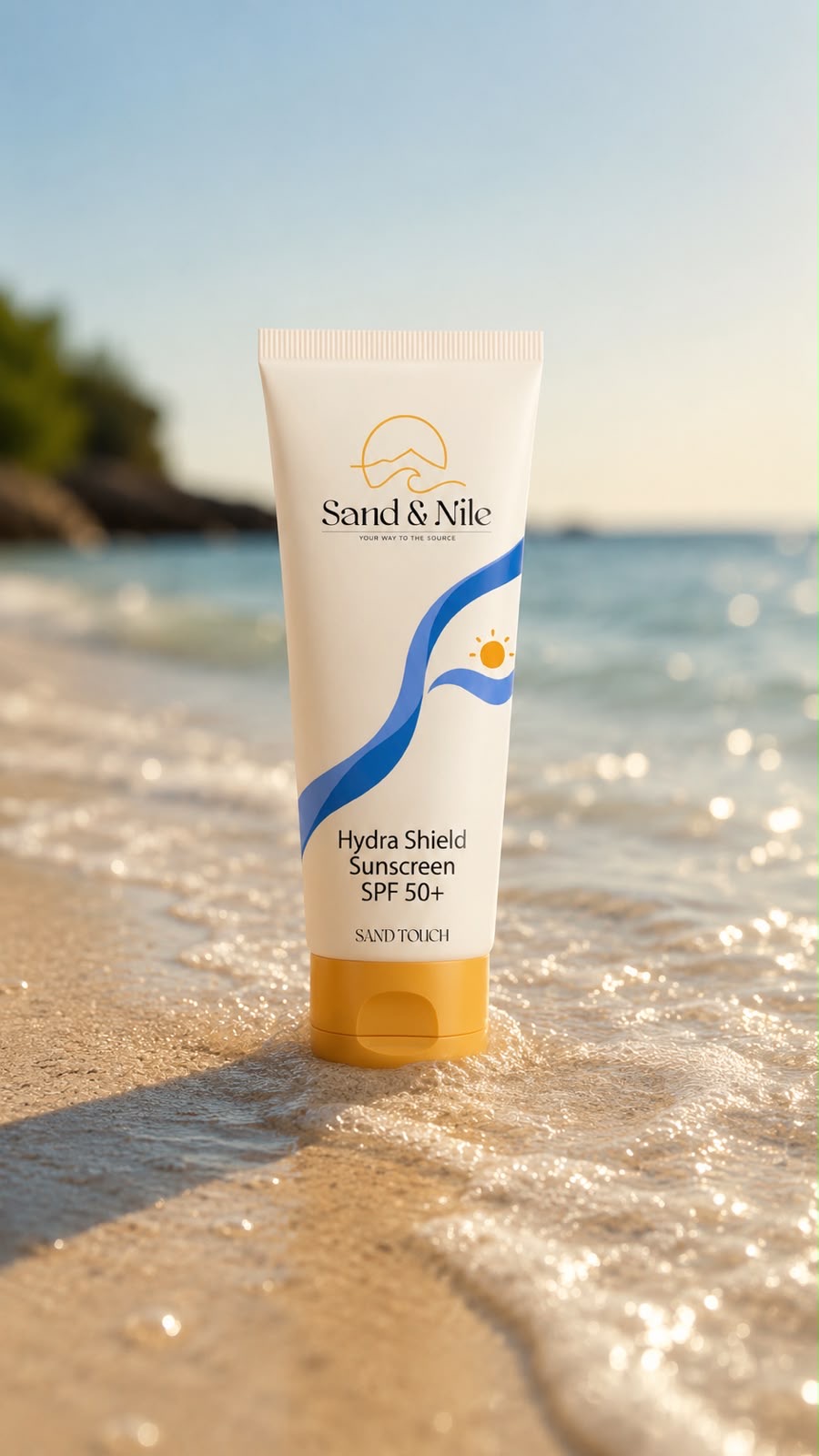
Where the sunscreen itself is meaningfully hydrating, an extra moisturiser is usually unnecessary. Sand Touch SPF 50+ is formulated for exactly this: hydration and protection in a single step, which also makes it a stable base under makeup.
Actives that require it
Some ingredients make daily protection non-negotiable rather than merely advisable. Retinoids, alpha and beta hydroxy acids, benzoyl peroxide and several prescription treatments increase photosensitivity and thin the stratum corneum temporarily. Using them without sunscreen does not simply waste the benefit — it raises the risk of irritation and post-inflammatory pigmentation.
The same applies after any resurfacing procedure. Post-treatment skin is photosensitised for weeks, and pigmentation acquired in that window is stubborn to reverse.
The antioxidant partnership
No filter system blocks one hundred per cent of incoming radiation, and none addresses visible light or infrared comprehensively. Antioxidants work on what gets through, neutralising reactive oxygen species before they oxidise lipids and proteins. Vitamin C in the morning beneath sunscreen is the best-documented pairing; formulas that carry antioxidant support internally extend the same logic.
Building a routine that survives contact with real life
A three-step morning that is actually performed outperforms a nine-step morning that is abandoned by March. Cleanse, treat, protect. Everything beyond that is refinement — welcome, but optional. The protection step is not.
Consider the arithmetic. A retinoid used nightly for a year represents a substantial investment of money and tolerance. Skipping sunscreen for the same year removes most of the return. Sunscreen is not the step that competes with your actives; it is the step that makes them worth buying.
The simplest luxury
There is something quietly luxurious about a routine that is short, consistent and effective. Protection every morning is the foundation of that — the discipline that lets everything else compound instead of merely maintaining.
The Journal
Sand Touch SPF 50+
Broad-spectrum protection in a hydrating base, designed for daily wear in regional light.