Why Korean Skincare Innovation Changed Sun Protection
Sunscreen stopped being a compromise when a formulation culture decided that texture was a scientific problem worth solving.

For most of the twentieth century, sunscreen was something to be endured. It was thick, it was white, it stung the eyes, and it was reserved for days when the alternative was a burn. The shift to what sunscreen is today — a step people look forward to — came largely out of one formulation culture, and the change was philosophical before it was chemical.
A different starting question
Western sunscreen development largely optimised for a single measurable outcome: the protection factor. Korean formulation began from a different premise — that daily use is the actual goal, and daily use is decided by sensory experience. Under that premise, texture, finish, scent and layering behaviour become primary technical specifications, not marketing afterthoughts.
This reframing had a measurable consequence. If a product must be worn every day, it must be pleasant at hour eight, invisible under makeup, comfortable in humidity and reapplicable without disruption. Those constraints are far harder to satisfy than a high SPF alone.
The regulatory advantage
Formulation freedom also mattered. Several modern organic filters — highly photostable, broad in coverage and elegant in texture — were approved for use across Asia and Europe long before they became available in some other markets. Access to a wider filter palette allowed formulators to design hybrid systems that achieved high protection at lower total filter load, which is precisely what produces a lighter feel.
Innovations that became standard
- Fluid and watery emulsions that spread into a continuous film with almost no drag.
- Cushion and stick formats that made reapplication over makeup realistic rather than theoretical.
- Hybrid mineral-organic systems that removed the white cast historically associated with zinc-led formulas.
- Hydration built into the sunscreen itself, collapsing two morning steps into one.
- Antioxidant and botanical support — green tea polyphenols, panthenol, centella — addressing oxidative stress alongside filtration.
Aqua care as skincare, not equipment
Perhaps the most consequential idea was categorical. Sunscreen was reclassified in consumers' minds from protective equipment to the concluding step of a skincare ritual. Once it belonged to the routine rather than to the beach bag, daily adherence rose — and adherence, not SPF arithmetic, is what determines long-term outcomes.
What this means for Sand Touch
Sand and Nile spent years distributing and studying premium Korean skincare in the Gulf and Egypt before formulating anything of its own. That period taught us a specific lesson: our region's requirement is not simply a higher number. It is high protection that survives 40°C afternoons, coastal humidity, air conditioning, makeup and reapplication — and that disappears on the full range of regional skin tones.
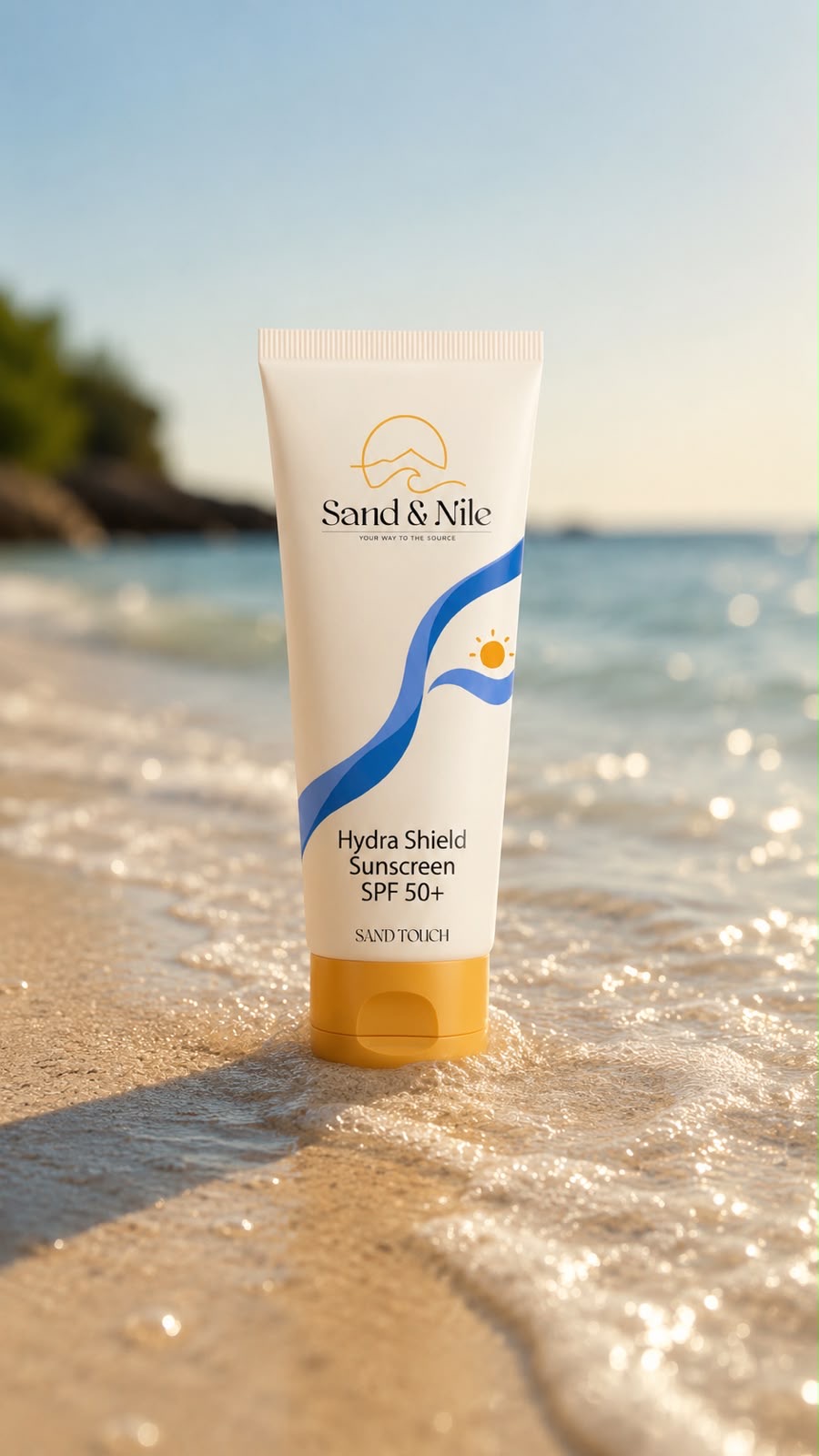
Sand Touch SPF 50+ is built on that brief. Korean formulation discipline, adapted to Middle Eastern conditions: broad-spectrum protection carried in a hydrating base light enough to wear every day, with a finish that works under makeup and does not grey deeper complexions.
The lesson worth keeping
The innovation was never only chemical. It was the decision to treat the user's daily experience as a scientific constraint of equal weight to the protection factor. Judged by outcomes — by how many people actually wear sunscreen every morning — that has proven to be the most effective advance in photoprotection in a generation.
The Journal
Sand Touch SPF 50+
Broad-spectrum protection in a hydrating base, designed for daily wear in regional light.